2025 may seem like just another year for our club, but in reality it brings with it challenges and pitfalls. Yes, 2025 is the second year of the new committee and it is also the year after the flood, so for us the most important word is CONFIRMATION!
Confirmation of the good work we have done during our first year at the helm of the club;
Confirmation that we have the support of most of our members;
Confirmation that we are aware that the number of members who are still sceptical about this committee is steadily decreasing;
Confirmation from our sponsors and partners that we are doing a good job;
Confirmation of the quality of our infrastructure, without forgetting that there is still a lot of work to be done to take it to an even higher level;
Confirmation that we have managed to remain united with the people of Lostallo, believe us, this was far from a foregone conclusion;
Confirmation that despite the (more than normal) departures expected from the committee, those who remain are motivated and have very clear ideas about the future of the club;
Confirmation that despite the passing years, the Lostallo track remains a popular destination for drivers and enthusiasts.
However, 2025 was also a year of competitions, and we can certainly say that they were all of an excellent standard and that they all had worthy winners! This year, we hosted two Swiss 1/5 Championship races, one Swiss V8 and V10 nitro Championship race, the 24H 1/5 team race, the PancarMaster and the EFRA 1/5 Grand Prix. Although the number of competitions we hosted on our track may seem small, finding people to fill the key positions in an R/C car competition is not easy because it requires competence, experience, free time, but above all, it takes the desire to help a club grow and always present quality events. We at MRTM always put our heart and soul into ensuring that all our guests return home with fond memories of their time spent with us!
2025 was the year in which the club made some important investments for the future:
– the technical inspection area was enlarged to allow for a better workflow during competitions
– software and hardware were purchased to manage all aspects of the club, from the bar till, bar/kitchen inventory, database, invoices issued, invoices to be paid, etc.
– a new, state-of-the-art illuminated scoreboard was purchased to display race results
– The necessary equipment was purchased to refurbish the track’s audio system.
In short, it was certainly not a year where we stood by and watched, but rather one where we fertilised and sowed the ground in order to reap the rewards during the 2026 1/5 World Championship and the 2027 GT8 and GT8E Championships!
The year 2024 begins in the best of ways with the execution of some planned maintenance work and the preparation of the first races on the calendar. Everything runs smoothly until one of the worst days in the history of Mesolcina.
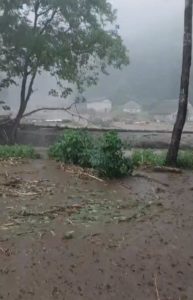
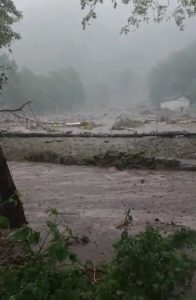
At the end of June 2024 a powerful water bomb unloaded all its fury on Lostallo and immediately the worst was thought for the guests of our campsite. Fortunately no one was injured or directly affected, but the scare was enormous and the images leave no room for imagination…
Unfortunately, however, on the other side of the valley, things are not so ‘quiet’ and Lostallo and the neighbouring municipalities have to deal with extensive damage, compromised roads and even a destroyed stretch of motorway, which makes things even more complicated! It is perhaps the worst time the valley has ever experienced.
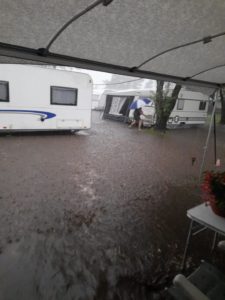
After the first alarm received from those present at the campsite, the Committee went as soon as possible to the site (the roads were impassable and the Police would not let anyone up to Lostallo) to check for themselves the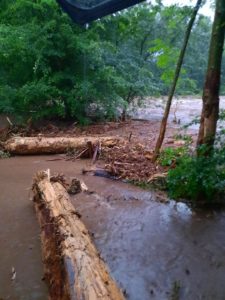 state of the situation and to carry out an initial inspection of the entire track infrastructure, buvette, toilets and showers, kitchen, covered pits and drivers’ box. Having carried out this inspection we can certainly declare ourselves MIRACULATE because our facility did not suffer any major damage!!!
Obviously, after realising the smallness of our problem compared to what had happened a few dozen metres away, the Committee immediately thought of cancelling the European 1/5 Championships that were to be held on our track in a month’s time, but before making any hasty decisions, we decided to talk to the municipal authorities to see what their point of view was.
Right from the start, the mayor and his staff expressed their desire to return to normality and the resumption of all activities as quickly as possible.
The Committee therefore decided to comply with the Lostallo municipality’s requests and we immediately set to work to solve mainly the problem of hosting the camp site, which was largely compromised. With everyone’s help, we managed to find a temporary solution to clear the ground of debris and to remove the trapped caravans from the most dangerous areas of the campsite.
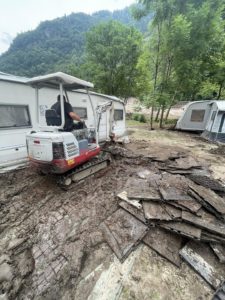
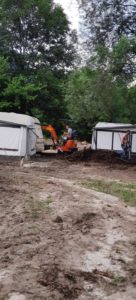
Thus began a struggle against time to make the camp site usable again, and here we saw cohesion, spirit of initiative, mutual help and support from everyone.
In addition to the users of our campsite, other people came to lend us a hand or provided us with means and machinery to meet our challenge.
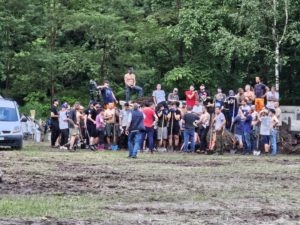
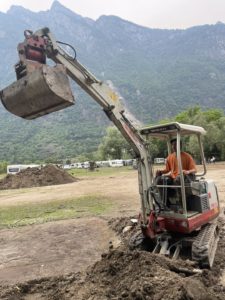
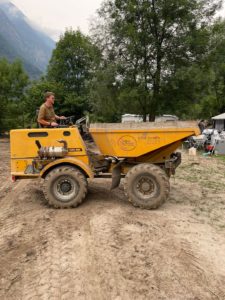
There are indeed many people to thank, but the committee would like to thank once again the Hockey Club Ambrì Piotta who, with the whole team and its coach, worked hard to make the ground fit again.
A HEARTFELT THANK YOU GOES TO ALL THOSE WHO SUPPORTED AND HELPED US DURING THIS PHASE, WHICH WAS NOT EASY TO MANAGE!!!
WE CAN ASSURE YOU THAT EVEN FROM A HUMAN PERSPECTIVE THIS EXPERIENCE TAUGHT US A LOT…
The period from 2005 to 2023 is well over 15 years of our history, which has been characterised by many important competitive events, but also by major changes in our infrastructure, which has become increasingly consolidated and stabilised in recent years.
Suffice it to say that in recent years our club has organised more than 200 competitions of varying calibre, from the social race to the national race, from the European Grand Prix to the absolute European Championship and, not to miss anything, even a few World Championships. We can certainly say that by now our track and our team have proved that they are up to the mark and are appreciated worldwide for their work and this should make all sympathisers, all members and all supporters of Mini Racing Ticino and Moesa proud.
Here are the most indelible and important memories that have marked our recent history:
In 2023, the historic president, Ernesto ‘Tino’ Camponovo, decided that he wanted to pass the baton to others, declaring that he wanted to do so because he was still able to make such a decision with the necessary lucidity. It happens that the committee in office that year resigns in full. A crucial moment in the life of the club, which will have to welcome a new team to direct future activities. What can I say, a team coming entirely from inland Switzerland (German) claims to be ready to take over, but here it is that in the moment of need a group of people, almost always close to the club, steps forward and creates a group intent on running the activities, but especially on maintaining a strong link between the club’s board and the territory (Italian-speaking Switzerland).
During the extraordinary assembly convened at the end of 2023, it is precisely these two groups that will play their cards on the table to ensure the continuity that such a track needs, and after the vote, the group let’s call it ‘of the Ticinesi’ comes out the winner. For the latter, the task will be, to say the least, arduous and full of pitfalls since they do not enjoy the consensus of the entire membership base from the outset.
The fact that during the summer of 2024 there will be an important event such as the European 1/5 Championship to be organised, might at first glance seem a problem, but instead this event is seen as a great opportunity to show all the members that the new committee is capable of organising important events, hoping that the trust in the new board will then be recognised.
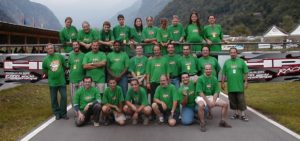
In 2002, the European Championships in the electric category took place. If before the start of the event, some drivers in this category were sceptical because they found the track too ‘big’ for small electric cars, in the end almost everyone agreed that they had rarely been able to race with so much space and without getting in each other’s way, while giving full power to the engines. Finland’s Levanen won after a more than exciting race.
Of course, in addition to this competition, there is a corollary of other competitions in the various categories, which increasingly increase the number of fans of this hobby.
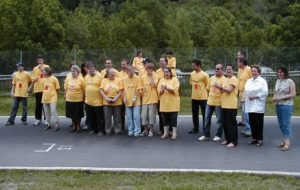
2003 is marked by the success of the Frenchman Volta in the European Championship B in the 1:8 category, but as always, this is only one of the many names of the various winners in the different races held throughout the season.
2004 was a year full of important races, in which no less than four European champions were crowned in four different categories at Lostallo: the Italian Burato won the EC over 40 in the 1:8 category; the Frenchman Levy won the 1:10 petrol car race (cat. 235 mm); the other Frenchman Comptat won the EC of the 1:4 GT/TC; the German Feldmann won the 1:5 Formula 1 race.
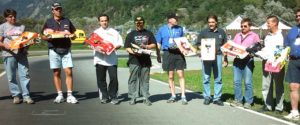
But preparations were also made for the World Championship that was awarded in Lostallo for 2005: the 1:5 category, the one that first awarded a European Championship in the Moesano.
During these years of competitions and after the success of the track, various improvements are gradually made to both the track (creation of new kerbs, fitting out the inside of the fast bends and more) and the track infrastructure. The catering area, for example, is being equipped with various comforts for both the public and those working there. A differentiated material collection area has been created. An irrigation system for the entire track has been installed and in time will be put into operation.
But also in the pits we can see many innovations: the compressed air stations have been increased; an area has been made available to the drivers where they can turn their tyres without dirtying their pits; some monitors have been placed between the pit tables, where they can see the chronometric progress of the race itself.
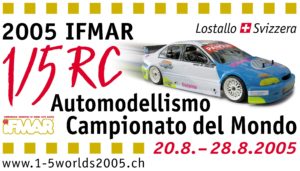
On the occasion of the 2005 World Championship, even more novelties are presented to the track’s regulars and non-frequent visitors: spectator stands, a ‘press room’ for the various newspapers, but above all a wireless computer connection system, which allows those present to connect with a laptop to the Internet, where the race results appear a few seconds after the end of each individual heat or final. It is now worthy of a big city airport!
In 2000, Switzerland’s Bühler won the European Over 40 Championship in the 1:8 category and Italy’s Busnardo the 1:10.
The 2001 season brings us 18 competitions. We have tried to reduce our efforts a little from a numerical point of view, but certainly not in terms of quality and quantity. That’s because in addition to the social races (seven of them, in which drivers from Switzerland and Italy also participate), the national races (1:8, 1:5, E10, FG, Tamiya), we are responsible for organising three Efra Grand Prix (1:5, E10 and 1:8 & 1:10 together) and the first official European Championship: the 1:5, with the best drivers from all over Europe already announced.
An honour but certainly also a burden!
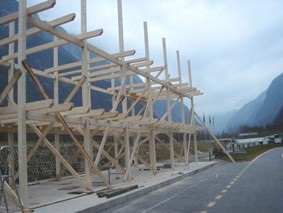
For this series of races, the tubular pilots’ platform can no longer fit (at least for us, because in other countries it would certainly have been more than enough), but above all we must be able to have an adequate infrastructure for the jury and the administration. Among other things, the British announced that they wanted to broadcast the European Championship live on the Internet minute by minute.
It is therefore decided to also build (well ahead of schedule) the infrastructure for the drivers’ box. For races of this kind you then need covered pits. After some information and some calculations, it soon becomes clear that it is better to take the next step and build them ourselves, rather than spend money on temporary covers.
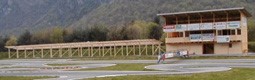
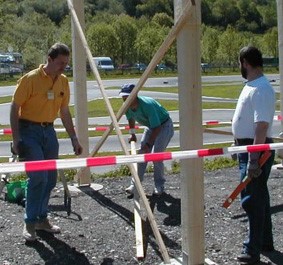
For the Efra 1:5 GP, one part of the covered pits (the one to the south) is ready. The one to the north is assembled precisely during the Europeans in front of the drivers from the other nations, who are astonished to see how quickly three people assemble the entire infrastructure.
However, there is still a lot to be done! At the end of June everything must be ready for the Europeans. For days, some members have been working tirelessly to be ready. Allow us to mention at least two names: Michele Denicolà and the usual Tino Camponovo.
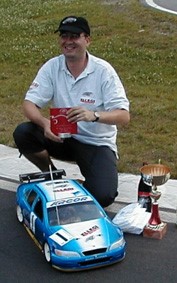
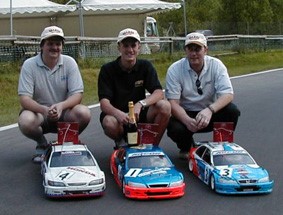
In June the event: the European championships begin and for a week it is a big party for the drivers and great work for the organisation. Compliments (fortunately) are not spared and Lostallo and the MRTM come out of this event with their heads held high and probably serious candidates for a world championship in the not too distant future for the 1:5 category.
This is followed in August by the two European Grand Prix: the 1:10 electric (Warm-Up for the 2002 European Championships, also in Lostallo) and the 1:8.
Of course, there are also the other national level competitions and above all a magnificent social championship with a large number of drivers, which in the 1:10 combustion category alone had 51 drivers classified at the end of the season.
“The time has come for the MRT to find a satisfactory solution for everyone, and so a project is born. The planned infrastructure complies with the regulations of the Swiss and European federation and will be available to members for training and the organisation of competitions at regional, Swiss and international level. The project was designed to be adapted to all categories of track car racing. During the study of the project, the probable future developments of the different categories were also taken into account. The infrastructure comprises: an asphalt track with a length of approximately 400 running metres (with a shorter and less fast variant for the electric categories), a drivers’ stand, timing and jury rooms, services, and a warehouse for maintenance equipment.
The focus was on finding as central a site as possible for the Ticino. But after a long and vain search, it is likely that the solution will be found outside the canton’s borders: in Lostallo (GR).
This was written back in 1996 when a booklet was published presenting the MRT’s 25 years of activity.
Much water has passed under the bridge since then. The first contacts made with the Lostallo municipality have become increasingly important. The municipality itself made great efforts to have our infrastructure built on a site that was suitable for it.
So much so that today the track is located on land whose zoning plan explicitly provides for the use of a track for radio-controlled cars. We are the only ones in Switzerland, but perhaps also in Europe, to have this right enshrined in law.
Unfortunately, bureaucracy and whatnot increasingly delay the possibility of building our dream. But finally the permits have arrived so that it can be built.
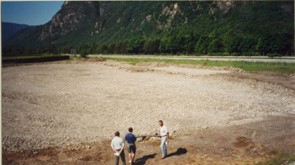
At least three years have passed since the first meetings. It is 1999 when the bulldozers start their work.
Meanwhile, the assembly decides to change the name of the club. In honour of the area that will host us, the club becomes the current Mini Racing Ticino and Moesa – MRTM.
On 4 September 1999, the track is ready to host its first race for radio-controlled cars. It is the qualifying race for the Tamiya European Championships. It is the first of 6 races that will take place in Lostallo within 2 months. It’s a big job, but it allows us to make ourselves known nationally and guarantee a series of races for the following year.
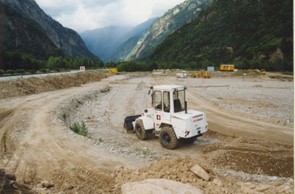
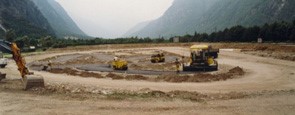
We have entered the new millennium and at the turn of June and July the first European Championship is held in Lostallo. Although not one of the categories fully recognised by Efra, this EC of 1:4 cars is a competition between true amateurs, many of whom build the parts themselves. These modelling enthusiasts are really pleased to be able to race on one of the very few tracks that allows them to race their giant bolides with complete peace of mind.
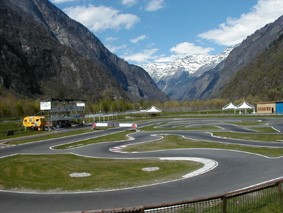
A real shot in the arm for Lostallo. The fact is that more and more requests are beginning to arrive to host top competitions on the Technokit Miniautodrome.
Because in the meantime the track has taken on a name, that of a sponsor who has seen in our track an ideal partner. An Italian company that has approached modelling by building a new 1:5 scale car. The philosophy is to be that of a new company linking up with a new track and both with synergy making themselves known in the world.
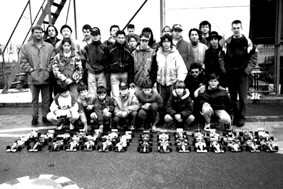
The world of modelling is changing and there is nothing left of the amateur hobby as it existed in the early seventies; the cars are sold in kit form and now have four-wheel drive, four suspension, two- or three-speed gearboxes, differentials, disc brakes and so on and so forth.
At this point a solution must be found! Camponovo (him again) then launches himself, as the lone navigator, into the adventure of the electric car.
The primary advantages of this category are: the smaller footprint to create a track, the total lack of noise from cars and the limited initial costs in purchasing a model.
Almost immediately it is imitated by other enthusiasts. It then becomes clear that a new solution must be found.
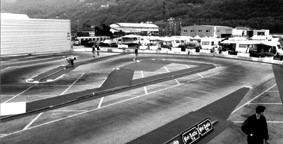
600 square metres of green carpeting were purchased. With these, transported inside a trailer donated by the company Trasporti Nessi, it is possible to organise races on any square. In fact, once on site, all that remains is to unroll the previously cut rolls of carpet and position them in such a way as to form a circuit between one piece and the next.
This system is also used to organise 1/8 races valid for the Swiss Combustion Engine Championship.
Success in the electric field reaches levels unhoped for even by the promoters themselves. It then becomes urgent to find a more stable solution.
Chocolat Stella, a confectionery company based in Giubiasco, enters the scene. The owners make the company’s car park available and a track is designed exclusively for electric cars
A Ticino Championship is organised, initially based on three distinct categories: Formula 1, DTM and the ‘Libera’ category. In the first two, Tamiya single-brand cars are chosen, so that everyone has the opportunity to have more or less similar vehicles. For the ‘Libera’, as the word itself says, the rule applies that all possibilities should be exhausted. Initially, this category seems to be quite successful, but it is soon drowned out by the other two, which instead put almost all drivers on an equal footing, who have to emerge thanks to their driving skills.
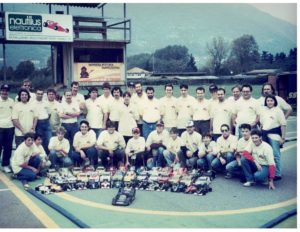
It is now 1993. Even the Swiss importer realises the success of the MRT and rewards us by giving us a race for the Tamiya Swiss Championship. In 1994 he even decides that Ticino becomes a region in its own right, while the rest of Switzerland is divided into two equal parts, because there are so many people in the canton alone that the creation of a region is more than justified.
In 1996, there were still three categories: Formula 1 (which kept its status virtually unchanged), DTM, which became the queen class and was opened up to other makes, and FWD (front-wheel drive), which more or less maintained the criteria of an equal car being a one-make.
History of the club since 1971
Writing the history of a club is always a difficult task: it is easy to get into the folds of anecdotes and, at the same time, leave out details and/or important people.
What follows is therefore a summary of what we managed to find in the club’s ‘archives’, but above all in the memories of some members who have been working with the MRTM for several years.
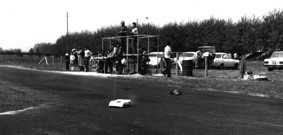
Radio-controlled model cars saw their beginnings in Ticino in 1970 thanks to a few enthusiasts who built Europe’s first permanent track in Magadino.
In 1971, the same people set up the Mini Racing Ticino – MRT.
After only four years, i.e. in 1975, on the occasion of the European Championships (won by the Italian Sabattini, a legendary name in world modelling), the Magadino track was extended.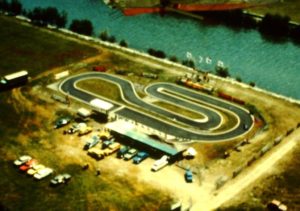
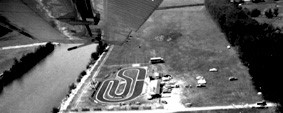
These were the golden years of radio-controlled modelling, the years when even those who wanted to build a car themselves could still do so. A chassis, a rigid axle, a drum brake on the clutch, and all that radio-control material, put there in some way, together with a motor bought in a specialised shop.
These are the years where it is more important to know how to drive a Spartan machine than to have the money to buy the best equipment; where the inventiveness of the individual is still rewarded.
In these years many enthusiasts approached the club and began their adventure. In the years between 1978 and 1982, a good group of young and old formed a Ticino team that was very fierce and feared on the slopes of Switzerland. A team that is able to have fun with little and is envied for its team spirit and cooperation on and off the track.
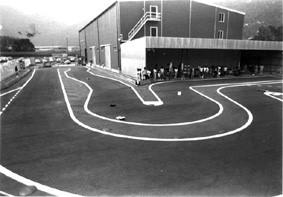
In 1983, after the umpteenth spillage of the Ticino river, which leaves quintals of sand on the track, the members decide to move to Losone at the Trasporti Nessi company, which puts the square at their disposal.
A track is drawn on the latter, which is coloured green to give the impression that it is a real circuit in the middle of a meadow. Never before had anyone thought of colouring the inside (or been able to).
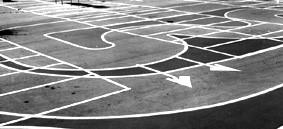
Unfortunately for the MRT, Nessi Transport is successful and is forced to increase the surface area of its halls, to the detriment of the runway, which is why it has to move again in 1988. The site was found thanks to the interest of Mr Leoni, owner of an auto centre in Riazzino. In his car park, which is also used by the Waro shop, he gives us the opportunity to design a new runway.
The space is large, and thanks to the skill of the draughtsman Camponovo, a new track is created that is tremendously technical and that drivers from all over Switzerland like to drive on. Once again the MRT takes the lead by creating the longest track in Switzerland with its 304 metres of development.
The neighbouring Waro shop, however, puts a spoke in the wheels of the MRT by building a trolley park right in the middle of the track. The club’s complaints turn out to be futile; the shop clearly pays, we don’t!
These are the MRT’s darkest years, the years where we see a decline in membership.
The mentality of the drivers themselves also causes many to drift away from the hobby. Nobody wants to give any weight to the emergence of the electric category, which is gaining ground in the rest of Switzerland.